
The four main types of printing techniques you'll encounter are relief, intaglio, lithography, and screen printing. Relief printing, accounting for 15% of commercial work, uses raised surfaces to transfer ink and is perfect for business cards and art prints. Intaglio works in reverse, with sunken designs ideal for currency and fine art. Lithography dominates modern commercial printing at 40% of all jobs, offering high speed and quality up to 2400 dpi. Screen printing excels in versatility, allowing thick ink deposits for everything from t-shirts to electronic components. Each method brings unique capabilities and advantages that can transform your printing projects.
Key Takeaway
- Relief printing uses raised surfaces for ink transfer, commonly seen in letterheads and business cards, accounting for 15% of commercial printing.
- Intaglio printing creates images by cutting or etching below the surface, producing detailed prints ideal for currency and fine art.
- Modern lithography dominates commercial printing with 40% market share, using oil-water repulsion principles for high-speed, high-quality results.
- Screen printing pushes ink through mesh screens to create durable prints on various surfaces like apparel, packaging, and electronics.
- Each printing method serves specific purposes: relief for texture, intaglio for detail, lithography for volume, and screen printing for versatility.
The Basics of Relief Printing
Relief printing stands as one of the oldest and most fundamental printing methods, where the printing surface has raised areas that transfer ink onto paper or other materials. You'll find this technique particularly fascinating, as it's similar to using a rubber stamp but on a more sophisticated level.
Key Components of Relief Printing:
- Printing block or plate
- Raised surface areas
- Water or oil-based inks
- Printing press or hand tools
When you're working with relief printing, you'll create your image by carving away the non-printing areas, leaving the raised portions to carry the ink. You'll discover that common materials include:
- Linoleum blocks
- Wood blocks
- Metal plates
- Rubber plates
The Process:
- You'll start by preparing your design on the printing block
- You'll carve away the negative space
- You'll apply ink to the raised surfaces
- You'll transfer the image using pressure
This method accounts for roughly 15% of commercial printing applications today, and you'll commonly see it used for:
- Custom letterheads
- Business cards
- Art prints
- Wood block prints
- Textiles
Inside Intaglio Printing Techniques
Unlike relief printing's raised surfaces, intaglio printing works in reverse – the image sits below the surface of the printing plate. In this sophisticated method, you'll find that artists and printmakers carve or etch their designs into metal plates, typically copper or zinc.
Key Intaglio Techniques:
- Etching: You'll use acid to bite into metal through an acid-resistant ground
- Engraving: You'll cut directly into the plate with sharp tools
- Aquatint: You'll create tonal variations using powdered rosin
- Mezzotint: You'll roughen the entire plate and then smooth areas for highlights
The Printing Process:
- Fill the grooves with ink
- Wipe the surface clean, leaving ink only in the recessed areas
- Press dampened paper into the grooves using high pressure (up to 2,000 psi)
- Pull the print, revealing crisp lines and rich tones
You'll notice intaglio prints by their distinctive plate mark – a slight indentation around the image where the paper was pressed into the plate. This technique's exceptional detail makes it perfect for fine art prints, currency, and high-end commercial applications.
Understanding Modern Lithography
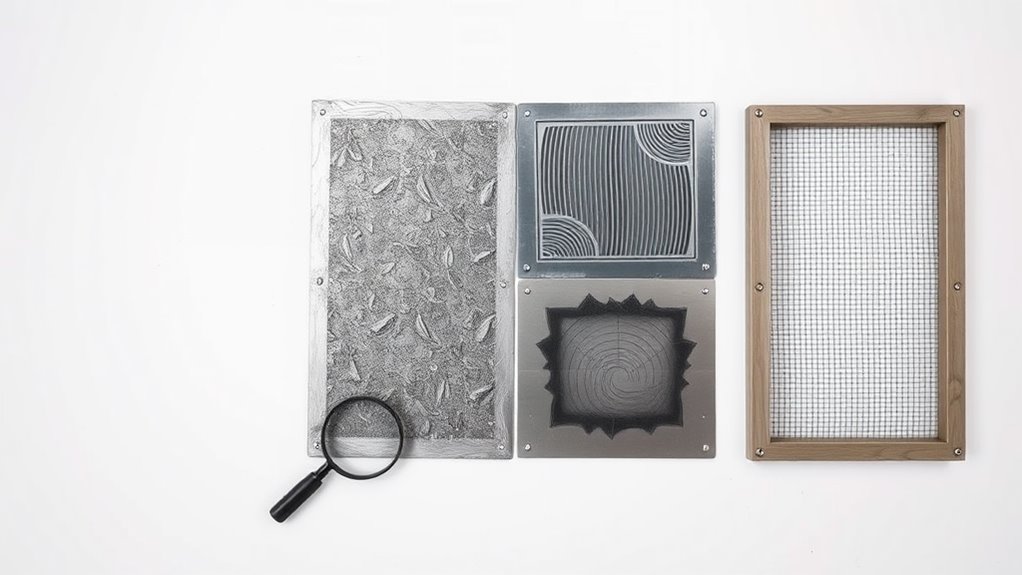
Modern lithography harnesses two fundamental principles – oil and water repulsion, plus chemical surface treatment. When you're working with modern lithographic printing, you'll find that the process relies on photosensitive chemicals that create printable and non-printable areas on specialized plates. You'll see that today's lithographic techniques have evolved considerably from their stone-based origins.
In commercial settings, you'll encounter these key components of modern lithography:
- Computer-to-plate (CTP) systems that directly image your printing plates with laser precision, achieving resolutions up to 2400 dpi
- Multi-color offset presses that can print 18,000 sheets per hour, using separate plates for each color
- Water-based fountain solutions that maintain non-image areas at precise pH levels between 4.5 and 5.5
- Oil-based inks that adhere only to the image areas, creating sharp, clean impressions
You'll notice that modern lithography dominates today's commercial printing industry, accounting for over 40% of all print jobs. When you're choosing a printing method, you'll appreciate lithography's combination of high speed, excellent quality, and cost-effectiveness for medium to large print runs.
Screen Printing Fundamentals
Screen printing stands as one of the most versatile printing methods you'll encounter in both commercial and artistic applications. You'll find this technique used across diverse materials, from t-shirts and posters to circuit boards and glass panels.
Key Components:
- Mesh screen (typically 110-305 threads per inch)
- Squeegee for ink distribution
- Frame to hold the mesh
- Photo-emulsion for stencil creation
How It Works:
You'll start by stretching a fine mesh across a frame, then apply photo-emulsion to create your stencil. When you expose the screen to light, your design areas remain open while other areas harden. You'll then push ink through these open areas using a squeegee, transferring your design onto the substrate below.
Advantages You'll Gain:
- Thick ink deposits (up to 200 microns)
- Ability to print on nearly any surface
- Cost-effective for medium runs (50-500 pieces)
- Excellent durability and wash resistance
Common Applications:
- Custom apparel printing
- Product packaging
- Electronic components
- Promotional materials
- Fine art prints
You'll need to take into account factors like mesh count, ink type, and substrate material to achieve the best results in your screen printing projects.
Choosing Your Printing Method
While screen printing offers distinct advantages, selecting the right printing method for your project involves careful consideration of multiple factors. You'll need to evaluate your specific requirements, including production volume, material type, and cost constraints, to make an informed decision.
Consider these key aspects when choosing your printing method:
- Production Volume:
- Digital printing: Ideal for 1-500 units
- Offset printing: Cost-effective for 1,000+ units
- Screen printing: Best for 50-5,000 units
- Flexographic printing: Efficient for 10,000+ units
You'll want to assess your project's color requirements, as each method handles color differently. Digital printing offers unlimited colors at no extra cost, while screen printing charges per color. Material compatibility is equally important – offset printing works best on paper, while screen printing excels on fabric and plastics.
Your timeline and budget will greatly influence your choice. Digital printing provides quick turnaround times but higher per-unit costs, whereas offset printing requires longer setup but delivers lower costs for large runs. Consider these factors carefully to align your printing method with your project's specific needs and objectives.
Common Applications and Uses
Various printing methods serve distinct purposes across different industries, with each technique offering unique advantages for specific applications.
Common Applications by Printing Type:
Digital Printing
- You'll find this method ideal for short-run marketing materials, business cards, and personalized direct mail
- Perfect for print-on-demand books and custom photo albums
- Best when you need quick turnaround times and variable data printing
Offset Printing
- You can use this for high-volume newspapers, magazines, and catalogs
- Ideal when you're printing packaging materials and branded stationery
- Most cost-effective for runs exceeding 500 copies
Screen Printing
- Your go-to choice for fabric printing, including t-shirts and promotional wear
- Effective for printing on irregular surfaces like bottles and containers
- Commonly used in circuit board manufacturing
Flexographic Printing
- You'll see this method in food packaging and label production
- Ideal for your continuous feed printing needs on flexible materials
- Perfect when you need to print on plastic bags and corrugated boxes
Each method's applications depend on your specific needs, including run size, substrate material, and quality requirements. You'll want to take into account these factors when selecting the right printing method for your project.
Future of Printing Technology
Through rapid technological advancements, the printing industry continues to evolve with innovative solutions that'll reshape how we produce and consume printed materials. You'll see transformative changes in how printing technology adapts to meet modern demands, particularly in sustainability and efficiency.
The future of printing technology brings several groundbreaking developments you'll want to watch:
- Nano-printing technologies that'll allow you to create microscopic patterns at scales smaller than 100 nanometers, revolutionizing electronics manufacturing
- Bio-printing capabilities that'll enable you to produce artificial organs and tissues for medical applications
- 4D printing systems that'll let you create objects that can change shape or properties over time
- Quantum dot printing that'll help you develop next-generation display technologies and solar cells
You'll find these emerging technologies dramatically improving print quality while reducing environmental impact. As you explore these innovations, you'll notice a shift toward hybrid printing solutions that combine traditional methods with digital technologies. The integration of artificial intelligence and machine learning will help you optimize print processes, reduce waste, and create more personalized printing experiences. You can expect to see these changes transform both commercial and personal printing applications within the next decade.
Conclusion
As you've explored the four pillars of printing – relief, intaglio, lithography, and screen printing – you're now equipped like a master craftsman with tools for any project. Each method flows into your creative arsenal like colors on an artist's palette, ready to bring your vision to life. Whether you're launching a business or expressing artistic ideas, you'll find these time-tested techniques are as relevant today as when they first revolutionized communication.