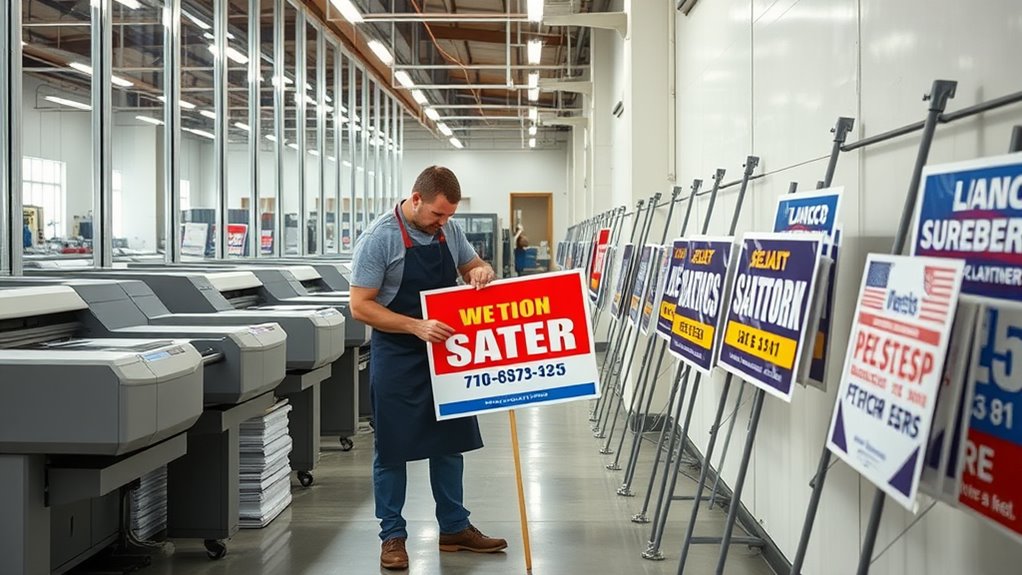
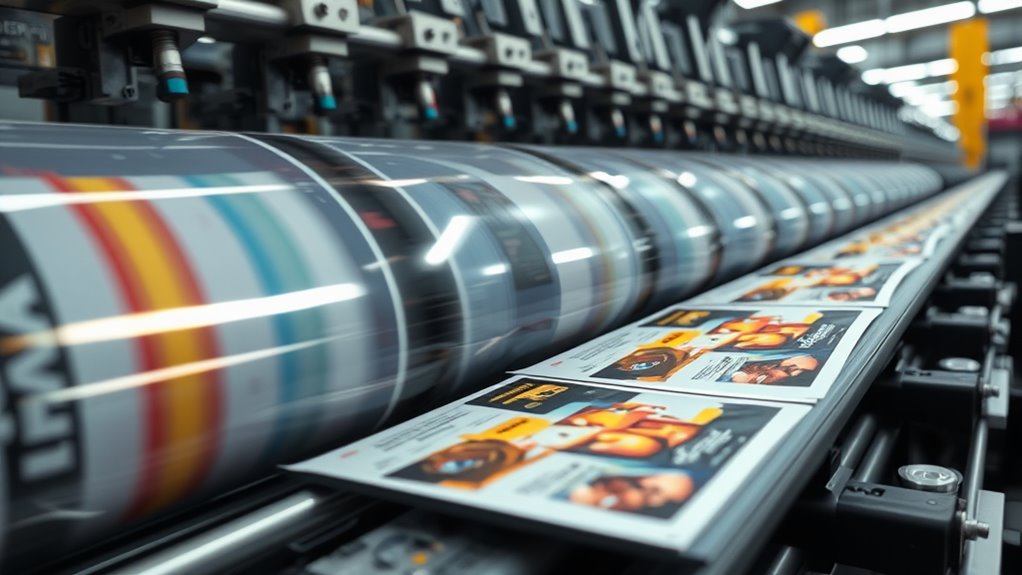
Commercial printing involves professional, large-scale printing services that businesses use to produce marketing materials, publications, and promotional items. You'll find it encompasses several key methods, including digital printing for quick turnaround jobs under 500 pieces, offset printing for larger volumes, and large format printing for banners up to 100 inches wide. These services typically deliver high-quality results with precise color accuracy (within Delta E values < 2.0) and resolutions of at least 300 DPI. While digital printing offers fast, customizable options, offset printing proves more cost-effective for bulk orders. Understanding the various printing methods can help you maximize your project's success.
Key Takeaway
- Commercial printing is a large-scale printing service for businesses that produces professional marketing materials, publications, and promotional items.
- It encompasses various printing methods including digital, offset, large format, and specialty printing to meet different business needs.
- Professional commercial printers use advanced technologies and maintain strict quality standards to ensure consistent, high-quality results.
- Services typically include printing brochures, business cards, banners, packaging, and marketing materials for organizations across multiple industries.
- Commercial printing offers cost-effective solutions for bulk orders while maintaining professional quality and brand consistency throughout print runs.
Types of Commercial Printing Services
Commercial printing services break down into several distinct categories that serve different business needs and production requirements. You'll find these core options available when you're ready to launch your next print project:
Digital Printing
- Perfect for short runs (under 500 pieces)
- Offers variable data printing for personalization
- Delivers quick turnaround times, typically 2-3 business days
- Provides cost-effective solutions for on-demand printing
Offset Printing
- Ideal for large-volume projects (500+ pieces)
- Guarantees consistent, high-quality color reproduction
- Accommodates specialty inks and finishes
- Proves more economical for bigger print runs
Large Format Printing
- Produces banners, posters, and signage up to 100" wide
- Includes outdoor-durable materials and UV-resistant inks
- Features options for rigid and flexible substrates
Specialty Printing
- Encompasses letterpress and screen printing
- Creates unique effects with foil stamping and embossing
- Handles unusual materials like metal, fabric, and plastic
- Delivers premium finishing options for high-end projects
You'll need to take into account factors like quantity, timeline, and budget when selecting the right printing method for your needs.
Equipment and Technology
Modern printing operations rely on sophisticated equipment and cutting-edge technology to deliver the various services mentioned above. You'll find that today's commercial printers utilize a thorough array of digital and mechanical systems to guarantee precision and efficiency.
Essential Equipment in Modern Printing:
- Digital prepress systems that'll process your files and prepare them for production
- Computer-to-plate (CTP) systems that create printing plates directly from digital files
- High-speed digital presses capable of producing up to 18,000 sheets per hour
- Large-format inkjet printers that can handle materials up to 98 inches wide
Key Technologies You'll Encounter:
- Variable data printing software that personalizes each printed piece
- Color management systems that guarantee consistency across all prints
- Automated finishing equipment for cutting, binding, and packaging
- Cloud-based workflow systems for real-time project tracking
You'll also find that most commercial printers now integrate artificial intelligence and automation to optimize production schedules and reduce waste. These smart systems can predict maintenance needs, adjust color calibration automatically, and even detect quality issues before they become problems.
Print Quality Standards
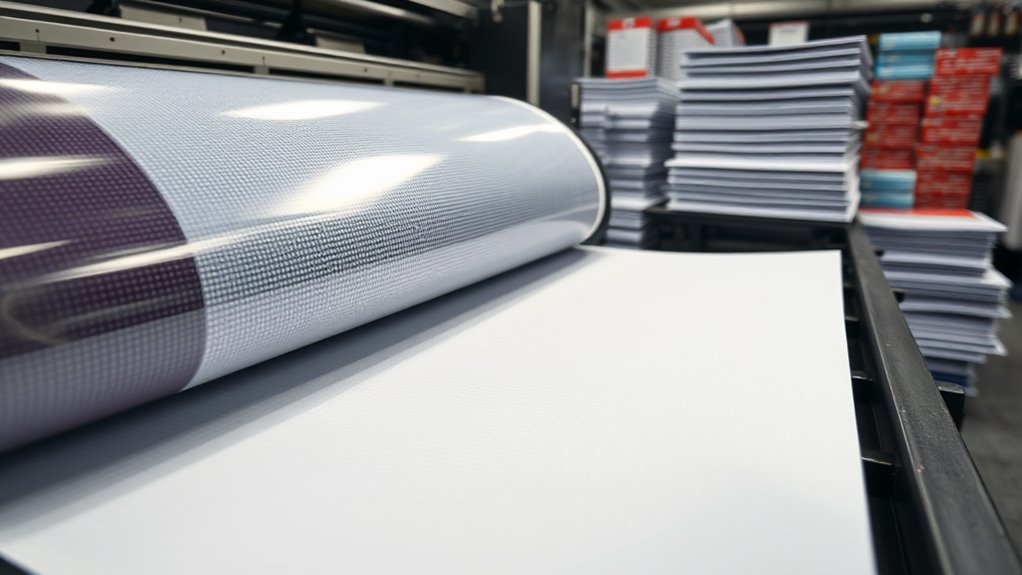
Quality standards in the printing industry represent a thorough set of benchmarks you'll need to meet for professional results. When you're evaluating print quality, you'll want to focus on several key metrics:
Color Accuracy and Consistency
- Delta E values should remain under 2.0 across print runs
- Color gamut matching within 95% of industry standards
- Pantone color accuracy within +/- 1.5 NBS units
Resolution and Detail
- Minimum 300 DPI for images
- Text clarity at 2400 DPI or higher
- Line work precision at 0.1mm tolerance
Print Consistency Standards
- Registration accuracy within 0.1mm
- Density variation no more than ±0.05
- Dot gain maintained at 18-22% midtone
You'll need to implement quality control measures throughout your printing process, including:
- Regular calibration of printing equipment
- ISO 12647-2 compliance for process control
- Use of standardized lighting conditions (D50)
- Implementation of G7 methodology for grayscale reproduction
Remember to document all quality checks and maintain detailed records of your color profiles, press settings, and environmental conditions to guarantee consistency across future print runs.
Cost Factors and Pricing
While maintaining high print quality standards remains a priority, understanding the cost structure of commercial printing will help you make informed business decisions and set competitive prices. You'll need to take into account multiple variables that affect your final pricing strategy, including materials, labor, and overhead costs.
Core Cost Components:
- Material costs – You're looking at paper stock (30-40% of total costs), ink usage (15-20%), and finishing materials like coatings or bindings
- Equipment operation – Your digital or offset printing equipment requires maintenance, calibration, and occasional repairs that factor into hourly rates
- Labor expenses – You'll need to account for operator time, setup costs, and specialized finishing work that requires skilled personnel
- Overhead allocation – Your facility costs, utilities, insurance, and administrative expenses need distribution across all jobs
When you're calculating project costs, you'll want to factor in run length, complexity, and turnaround time. You can expect setup costs to decrease per unit as quantity increases, making larger runs more cost-effective. Digital printing typically proves more economical for short runs, while offset becomes competitive at higher volumes, usually above 500 units.
Environmental Impact and Sustainability
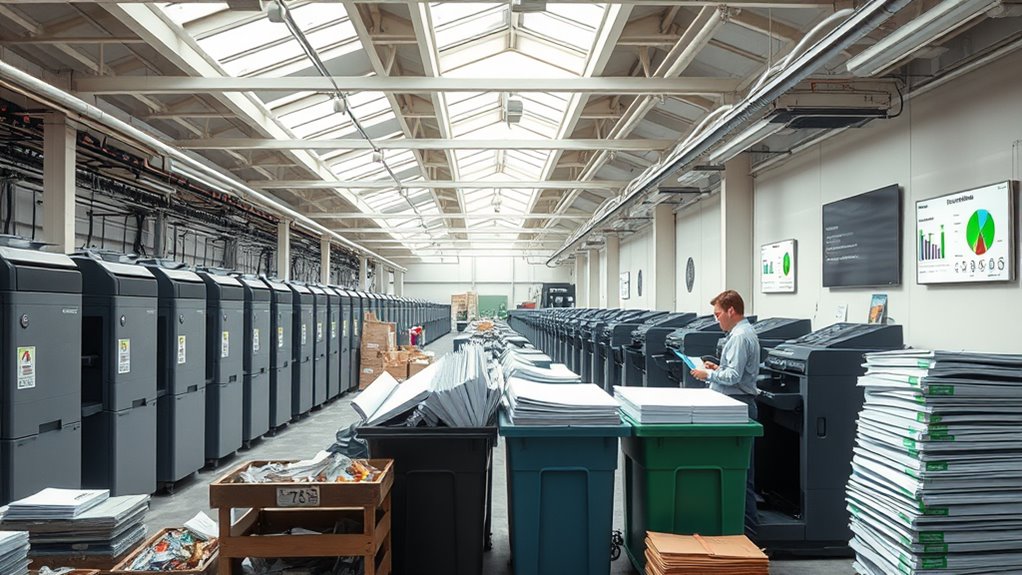
Throughout the printing industry, environmental concerns have sparked significant changes in materials, processes, and waste management practices. You'll find that modern commercial printers are adopting eco-friendly solutions to reduce their carbon footprint and meet growing sustainability demands.
Key Environmental Initiatives:
- Vegetable-based inks have replaced traditional petroleum-based products, reducing VOC emissions by up to 70%
- FSC-certified papers guarantee responsible forestry management
- Digital printing technology minimizes paper waste and chemical usage
- Water-based coatings provide environmentally safer alternatives to UV varnishes
Waste Reduction Strategies You Can Implement:
- Print-on-demand services to eliminate excess inventory
- Digital proofing systems to reduce paper waste
- Recycling programs for paper, plates, and chemicals
- Energy-efficient equipment upgrades
You'll notice that sustainable printing practices aren't just good for the environment—they're good for business. By choosing green printing options, you're reducing operational costs while meeting consumer demands for eco-friendly products. Many printers now offer carbon-neutral printing services, allowing you to offset your project's environmental impact through verified conservation programs.
Business Applications and Solutions
Modern businesses leverage commercial printing services across diverse operational needs, from marketing collateral to administrative documents. You'll find that integrating professional printing solutions into your operations can streamline workflow, enhance brand consistency, and deliver measurable ROI across multiple departments.
Today's commercial printing solutions offer you scalable options that adapt to your business requirements:
- Marketing Materials: You can produce high-quality brochures, catalogs, and direct mail pieces that capture your audience's attention with precise color matching and premium finishes
- Corporate Documentation: You'll maintain professional standards with consistent templates for business cards, letterheads, and training manuals
- Large Format Solutions: Your retail spaces and trade show displays can feature eye-catching banners, posters, and signage that drive engagement
- Variable Data Printing: You're able to personalize communications at scale, achieving 35% higher response rates compared to generic materials
When you're selecting a commercial printing partner, consider their technological capabilities, turnaround times, and quality control processes. Modern print management systems can integrate with your existing business software, allowing you to track orders, manage inventory, and analyze usage patterns efficiently.
Conclusion
As you've seen, commercial printing isn't just putting ink on paper – it's a full-service industry that's hitting the ground running in today's digital age. You'll find that modern printing services combine traditional techniques with cutting-edge technology to meet your business needs. Whether you're scaling up marketing materials or producing custom packaging, commercial printing continues to evolve while maintaining quality standards and environmental responsibility.