
Commercially printed materials are produced using professional-grade printing equipment and standardized processes in a print shop or manufacturing facility. You'll find that commercial printing encompasses several methods, including offset lithography for large runs, digital printing for smaller quantities, flexography for packaging, and gravure for premium products. These methods utilize industrial equipment capable of producing thousands of pieces per hour while maintaining strict quality control standards for color accuracy, registration, and finishing. Commercial printing differs from desktop or home printing by offering higher quality, larger volumes, specialized finishes like UV coating and foil stamping, and more cost-effective per-unit pricing. Exploring the various methods can help you choose the best option for your project needs.
Key Takeaway
- Commercial printing refers to professional, large-scale printing services performed by specialized companies using industrial-grade equipment and standardized processes.
- It involves printing materials for business purposes using methods like offset lithography, digital printing, flexography, or gravure printing.
- Quality control standards, including color calibration, registration accuracy, and industry certifications, distinguish commercial printing from consumer-grade printing.
- Commercial printing encompasses various finishing processes like UV coating, die-cutting, and binding to create professional-quality printed materials.
- It's designed for mass production and bulk orders, offering economies of scale with reduced per-unit costs for larger quantities.
Types of Commercial Printing Methods
Commercial printing encompasses four primary methods: offset lithography, digital printing, flexography, and gravure printing. Let's explore how each of these methods can serve your business needs and production requirements.
Offset Lithography
- You'll find this method ideal for high-volume projects (10,000+ pieces)
- Delivers superior image quality through a plate-to-rubber-to-paper process
- You can expect costs of $0.03-0.15 per piece for large runs
Digital Printing
- Perfect when you need quick turnaround times and variable data
- Offers cost-effective solutions for small runs (under 500 pieces)
- You'll appreciate the flexibility to make last-minute changes
Flexography
- Your go-to choice for packaging, labels, and flexible materials
- Provides excellent results on non-flat surfaces
- You can achieve printing speeds up to 2,000 feet per minute
Gravure Printing
- Choose this for premium quality on long runs
- You'll get consistent results with metallic inks and specialty finishes
- Ideal for magazines, catalogs, and high-end packaging
Each method has its sweet spot regarding cost-effectiveness and application. You'll want to evaluate your project's volume, timeline, and quality requirements when selecting the right process.
Equipment and Technology
Modern printing facilities rely upon an extensive array of specialized equipment to deliver professional results. You'll find that today's commercial printers integrate advanced digital technologies with traditional mechanical systems to guarantee peak quality and efficiency.
The core equipment you'll encounter in a modern commercial printing facility includes:
- Digital pre-press systems that process your files and create printing plates, featuring color management software and workflow automation tools
- High-speed offset presses that can print up to 18,000 sheets per hour, with automated ink control and registration systems
- Digital printing machines capable of variable data printing and short-run jobs, offering resolutions up to 2400 dpi
- Finishing equipment including cutters, folders, and binding machines that transform printed sheets into finished products
You'll notice that modern printing technology emphasizes automation and precision, with computer-integrated manufacturing (CIM) systems coordinating various processes. The integration of Internet of Things (IoT) sensors and real-time monitoring guarantees consistent quality throughout production. When you're working with a commercial printer, you'll benefit from their investment in these technologies, which typically ranges from $500,000 to several million dollars per facility.
Quality Control Standards
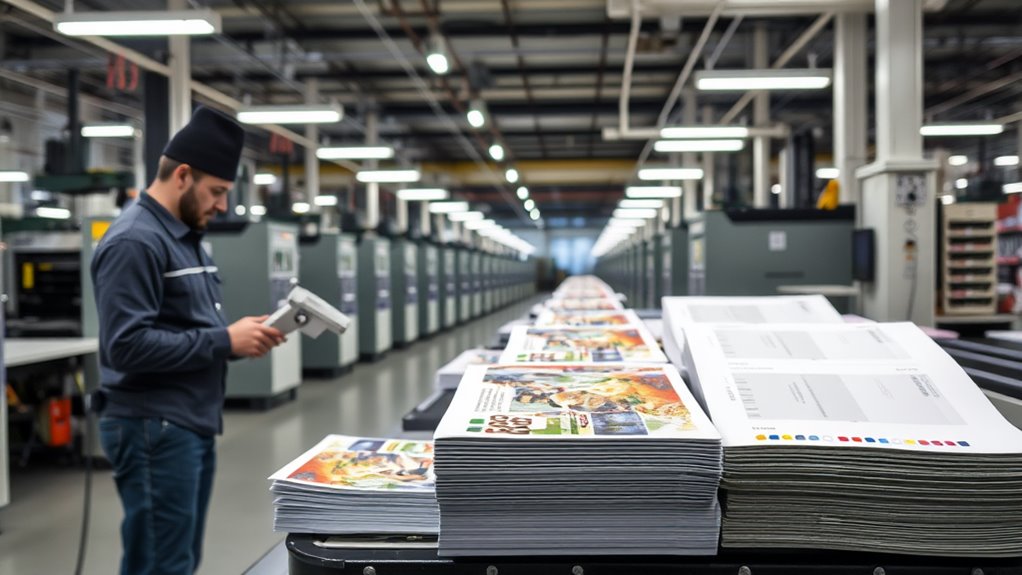
Throughout the printing process, quality control standards serve as the backbone of professional production, ensuring every piece meets rigorous specifications. You'll find that commercial printers implement strict protocols to maintain consistency across all printed materials.
Key Quality Control Measures:
- Color calibration: You'll need to match precise Pantone standards within a 2% variance
- Registration accuracy: Your prints must align within 0.1mm tolerance
- Paper stock verification: You'll want to confirm weight, texture, and coating specifications
- Ink density measurements: Your prints should maintain consistent saturation levels
When you're working with commercial printers, they'll typically follow these industry standards:
- ISO 12647-2 for offset lithography
- G7 certification requirements
- SWOP (Specifications for Web Offset Publications)
- GRACoL (General Requirements for Applications in Commercial Offset Lithography)
You'll notice that modern quality control systems incorporate automated inspection technology that can detect:
- Color variations
- Registration errors
- Missing elements
- Surface defects
- Ink coverage issues
Materials and Finishing Processes
Professional printing relies heavily on the interplay between material selection and finishing processes to achieve desired results. When you're choosing materials for your commercial printing project, you'll need to take into account factors like durability, cost-effectiveness, and environmental impact. Your selection of paper stock, inks, and coatings will greatly influence the final product's quality and longevity.
The finishing processes you'll encounter in commercial printing include various techniques that enhance your printed materials:
- UV coating application, which provides a glossy finish and protects against wear while offering 98% scratch resistance
- Die-cutting operations that create custom shapes and edges, allowing you to differentiate your materials from standard rectangular formats
- Foil stamping techniques that add metallic elements, increasing perceived value with reflective surfaces that capture attention
- Perfect binding, saddle stitching, or case binding methods that transform loose pages into professional publications
You'll find that these finishing touches can transform basic printed materials into premium products. When you're planning your project, think about how combining different materials with specific finishing processes will help you achieve your desired outcome while staying within budget constraints.
Cost Factors and Production Scale
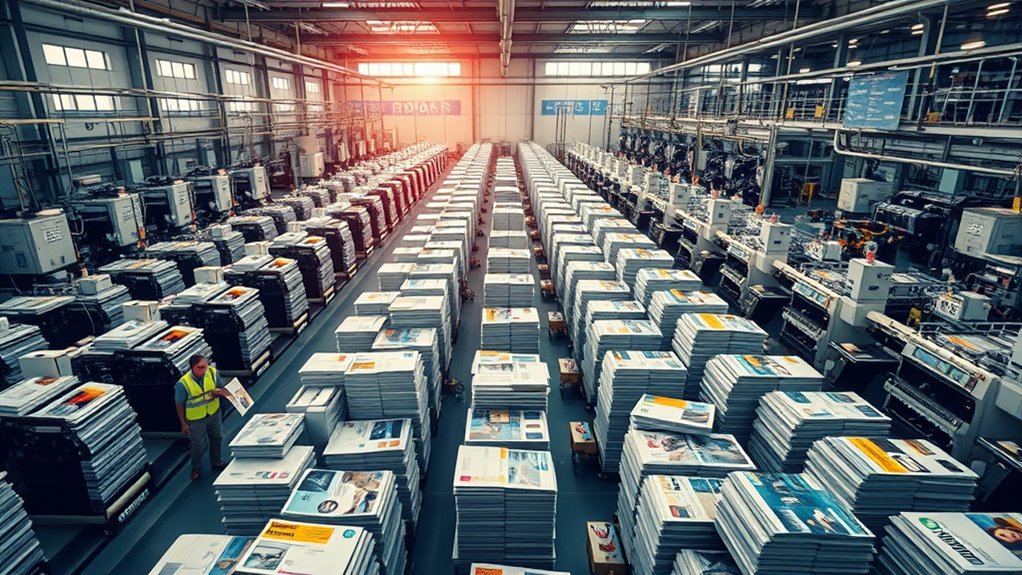
Production costs in commercial printing depend heavily on your scale of operation and several key variables that affect the bottom line. You'll find that volume markedly influences your per-unit costs, with larger print runs typically reducing your price per piece.
Key Cost Determinants:
- Print quantity (economies of scale)
- Paper stock and quality
- Number of colors
- Finishing requirements
- Production timeline
- Equipment utilization
Volume-Based Pricing Example:
- 500 brochures: $1.20 per unit
- 5,000 brochures: $0.45 per unit
- 10,000 brochures: $0.30 per unit
When you're planning your commercial print project, you'll need to take into account both fixed and variable costs. Fixed costs include setup, plate creation, and initial equipment configuration, while variable costs encompass materials, labor, and finishing processes. You can optimize your costs by:
- Bundling similar projects together
- Choosing standard paper sizes
- Planning ahead for seasonal demands
- Utilizing automated workflows
Your production scale will determine equipment choices, from digital presses for short runs to offset printing for high-volume jobs. Keep in mind that digital printing becomes cost-effective under 500 units, while offset printing shows better returns above 1,000 units.
Conclusion
You've learned that commercially printed materials represent professional-grade products created using industrial printing equipment and standardized processes. As they say, "quality is remembered long after price is forgotten," which holds especially true in commercial printing. Whether you're choosing offset, digital, or flexographic methods, you'll get consistent, high-volume results that meet industry standards. Remember, commercial printing isn't just about mass production – it's about delivering reliability and professional excellence at scale.