
The standard U.S. business card size of 3.5 x 2 inches (88.9 x 50.8 mm) remains your safest choice, as it's widely accepted and compatible with most card holders and printing services. You'll want to include a 0.125-inch bleed area on each side and keep essential elements 0.25 inches from edges for professional results. While creative industries often experiment with alternative sizes like 2.5-inch squares or oversized 3.5 x 2.5-inch formats, your choice should align with your industry standards and practical considerations. Regional variations exist, with European cards measuring 85mm x 55mm and Japanese cards at 91mm x 55mm. Understanding these specifications and design requirements will help you make the most informed decision for your business needs.
Key Takeaway
- The standard U.S. business card size of 3.5 x 2 inches remains the most widely accepted and practical choice for professional use.
- Include a 0.125-inch bleed area on all sides and keep important content within a 0.25-inch safe zone from edges.
- Set up digital designs at 3.75 x 2.25 inches with 300 DPI in CMYK color mode for optimal printing results.
- European businesses should consider the ISO standard size of 85mm x 55mm for better regional compatibility.
- Creative industries can explore alternative sizes like 2.5" x 2.5" square cards, while corporate sectors should stick to standard dimensions.
Standard Business Card Dimensions
While business card sizes can vary slightly by region, the standard dimensions in the United States are 3.5 x 2 inches (88.9 x 50.8 mm). You'll want to keep these measurements in mind when creating your design, as they've become the industry standard for printing and storage solutions.
Key Dimensions to Remember:
- Width: 3.5 inches (88.9 mm)
- Height: 2 inches (50.8 mm)
- Bleed area: Add 0.125 inches (3.175 mm) on each side
- Safe zone: Keep important elements 0.25 inches (6.35 mm) from edges
When you're designing your business card, you'll need to account for the bleed area, which extends beyond the final cut size. This guarantees you won't have unwanted white edges if there's any slight misalignment during printing. The safe zone is equally important – it's where you'll want to keep your essential information, like contact details and logos.
For digital designs, you should set up your file at:
- 3.75 x 2.25 inches (with bleed)
- 300 DPI resolution
- CMYK color mode
These specifications will help guarantee your business cards print professionally and maintain consistency across different printing services.
Alternative Size Options
Creative professionals and entrepreneurs sometimes opt for non-standard business card sizes to stand out from the competition. You'll find several alternative dimensions that can help your brand make a lasting impression while still maintaining practicality.
Popular Alternative Sizes:
- Square Format: 2.5" × 2.5" or 2" × 2" – perfect for Instagram-focused businesses or photographers
- Mini Cards: 2.5" × 1" – ideal for minimalist designs and quick contact sharing
- Oversized Cards: 3.5" × 2.5" – offers more space for detailed information or striking visuals
- European Standard: 3.346" × 2.165" – slightly longer than U.S. cards
When choosing an alternative size, you'll need to take into account:
- Printing costs (typically 15-30% higher than standard sizes)
- Storage compatibility with standard card holders
- Postal regulations if you're planning to mail them
- Paper stock limitations for unusual dimensions
While non-standard sizes can make you memorable, they should align with your brand strategy and target audience. You'll want to test your chosen format with a small batch first, ensuring it meets your practical needs before committing to a larger order.
Regional Size Differences

Business card dimensions vary greatly across different regions of the world, reflecting local customs and standardization practices. You'll need to take into account these regional differences when designing cards for international use.
Common Regional Standards:
- North America: 3.5" × 2" (88.9mm × 50.8mm)
- Europe/UK: 85mm × 55mm
- Japan: 91mm × 55mm (called "meishi")
- China/Hong Kong: 90mm × 54mm
- Australia: 90mm × 55mm
When you're planning international business cards, you'll want to factor in these size variations to guarantee proper printing and cultural appropriateness. For instance, Japanese business cards traditionally use slightly larger dimensions to accommodate both Japanese characters and Roman text.
Regional Considerations:
- European sizes align with ISO standards and credit card dimensions
- Asian markets often prefer slightly larger cards for dual-language text
- North American sizes work well with standard wallet card slots
- Australian dimensions closely follow European standards
You can optimize your design by creating a flexible layout that adapts to different regional sizes while maintaining your brand integrity. Think about using a design that works across multiple dimensions without losing impact or readability.
Industry-Specific Size Considerations
Different industries have unique requirements for business card sizes based on their specific needs and professional expectations. When you're working in creative fields like design or photography, you'll often benefit from larger formats that showcase your visual work, while traditional sectors like banking or law typically stick to standard sizes.
You'll want to take into account these industry-specific factors when choosing your card size:
- Creative Industries (Design, Art, Photography)
- Recommended size: 3.5" x 2.5" or larger custom sizes
- Allows for portfolio samples and artistic layouts
- 73% of creative professionals use non-standard sizes
- Corporate/Financial Sectors
- Standard size: 3.5" x 2" (US) or 85mm x 55mm (EU)
- Fits traditional card holders and wallets
- Projects stability and convention
- Technology/Startups
- Modern square formats (2.5" x 2.5")
- Digital integration capabilities (QR codes, NFC)
- 45% include interactive elements
You'll need to balance innovation with practicality when selecting your card size, ensuring it aligns with your industry's expectations while still reflecting your brand's unique identity. Reflect on your target audience's preferences and how they'll typically store and use your card.
Design Impact of Card Size
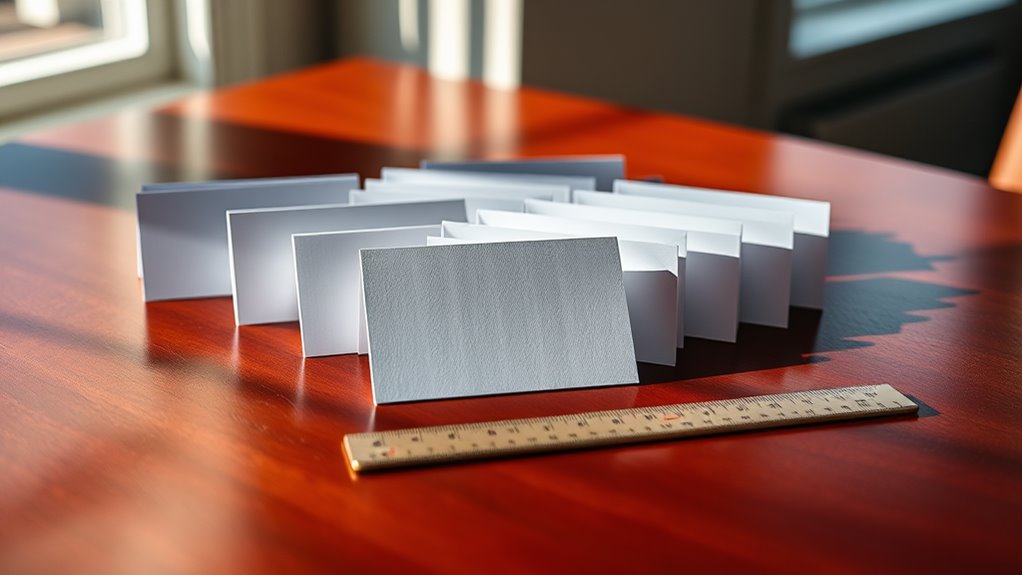
The size of your card directly influences every aspect of your design strategy, from typography choices to image placement. When you're working with standard 3.5" x 2" dimensions, you'll need to carefully consider how each element fits within this confined space.
Design Elements and Sizing Guidelines:
- Typography: Choose font sizes between 8-12pt for body text and 12-16pt for headers to maintain readability
- Logo placement: Allocate 25-30% of card space for your primary branding elements
- Margins: Keep a minimum 0.125" safe zone from all edges
- White space: Reserve 30-40% for visual breathing room
Size-Related Design Considerations:
- Vertical vs. horizontal orientation affects content hierarchy
- Smaller cards (like European 85mm x 55mm) require more selective content choices
- Oversized cards need proportionally larger design elements
You'll want to test your design at actual size throughout the creative process, as screen views can be deceiving. Remember that unusual sizes might impact printing costs and storage solutions, so balance your creative vision with practical constraints. Consider how your card will interact with standard holders and wallets when finalizing dimensions.
Printing and Production Factors
When preparing your business card for print production, several key factors will influence both quality and cost. You'll need to take into account standard printing press configurations, paper stock limitations, and finishing options that work within industry parameters.
Most commercial printers maximize their equipment for traditional card sizes, which means custom dimensions can greatly increase your production costs. You'll find that standard sizes also guarantee compatibility with common card holders and scanning devices, making your card more practical for networking purposes.
Key production considerations include:
- Paper weight selection – 100lb to 130lb cover stock offers ideal durability without becoming too bulky or causing feeding issues in printing equipment
- Bleed requirements – Standard 1/8 inch bleed on all sides prevents unsightly white edges and guarantees proper trimming
- Color specifications – CMYK process printing typically costs less than specialty Pantone inks, while still delivering professional results
You'll want to discuss these specifications with your printer before finalizing your design. Many printers offer templates that account for these factors, helping you avoid costly revisions and guaranteeing your cards meet quality standards without exceeding your budget.
Conclusion
While you'll find various business card sizes in today's digital world (just like those floppy disks of yesteryear), sticking to standard dimensions remains your safest bet. Whether you're choosing the North American standard (3.5 x 2 inches) or international measurements, you'll want to take into account your industry, region, and printing requirements. Remember, your card's size directly impacts its design potential and professional impression, so choose thoughtfully to maximize your networking impact.