Several effective digital alternatives to traditional flyers can boost your marketing reach and ROI. Email newsletters offer targeted messaging with an average $42 return for every dollar spent, while social media advertising provides precise audience targeting with 80% of marketers reporting better ROI. You can also leverage QR codes on business cards and packaging, mobile apps with push notifications that achieve 90% open rates, and interactive digital signage that generates 400% more views than static displays. SMS campaigns and location-based marketing round out your modern promotional toolkit, offering innovative ways to engage customers and track results. Exploring these options will reveal powerful new ways to connect with your audience.
Key Takeaway
- Digital newsletters and email marketing campaigns offer targeted reach with an average ROI of $42 for every $1 spent.
- QR codes on business cards and product packaging provide instant digital access to information and promotional content.
- Interactive digital signage generates up to 400% more views than static displays and allows real-time content updates.
- Mobile apps with push notifications achieve 90% open rates within 3 minutes and enable cost-effective, location-based targeting.
- Social media advertising enables precise audience targeting with flexible budgeting and instant performance tracking capabilities.
Digital Newsletters and Email Marketing
Digital newsletters and email marketing campaigns offer three distinct advantages over traditional flyers: targeted reach, real-time analytics, and cost-effectiveness.
When you switch to digital newsletters, you'll gain access to powerful segmentation tools that let you divide your audience based on:
- Demographics and location
- Purchase history and preferences
- Engagement levels and behaviors
Your email campaigns can deliver measurable results through:
- Open rates (industry average: 21.33%)
- Click-through rates
- Conversion tracking
- A/B testing capabilities
You'll find that email marketing is considerably more budget-friendly than printing flyers, with an average ROI of $42 for every $1 spent. Plus, you can quickly adjust your content, offers, and design without additional printing costs.
To maximize your digital newsletter's effectiveness:
- Create mobile-responsive designs
- Personalize subject lines and content
- Include clear calls-to-action
- Schedule sends based on audience activity patterns
Unlike traditional flyers that end up in recycling bins, your digital communications can be saved, shared, and referenced repeatedly. You'll also reduce your environmental impact while maintaining consistent communication with your target audience.
Social Media Advertising
Key Benefits:
- Precise audience targeting based on age, location, interests, and online behaviors
- Real-time performance tracking and analytics
- Flexible budgeting options starting as low as $5 per day
- Visual and video-based content opportunities
Implementation Strategies:
- Choose your platform based on where your target audience is most active
- Create compelling visual content that stops users mid-scroll
- Test different ad formats (carousel, stories, feed posts)
- Monitor metrics and adjust campaigns accordingly
You'll find that social media advertising offers considerably more targeting precision than traditional flyers, with 80% of marketers reporting better ROI from social campaigns. With built-in analytics tools, you can measure engagement rates, click-throughs, and conversions in real-time. Plus, you'll have the ability to adjust your campaigns instantly based on performance data, ensuring your marketing budget works harder for your business.
QR Code Marketing
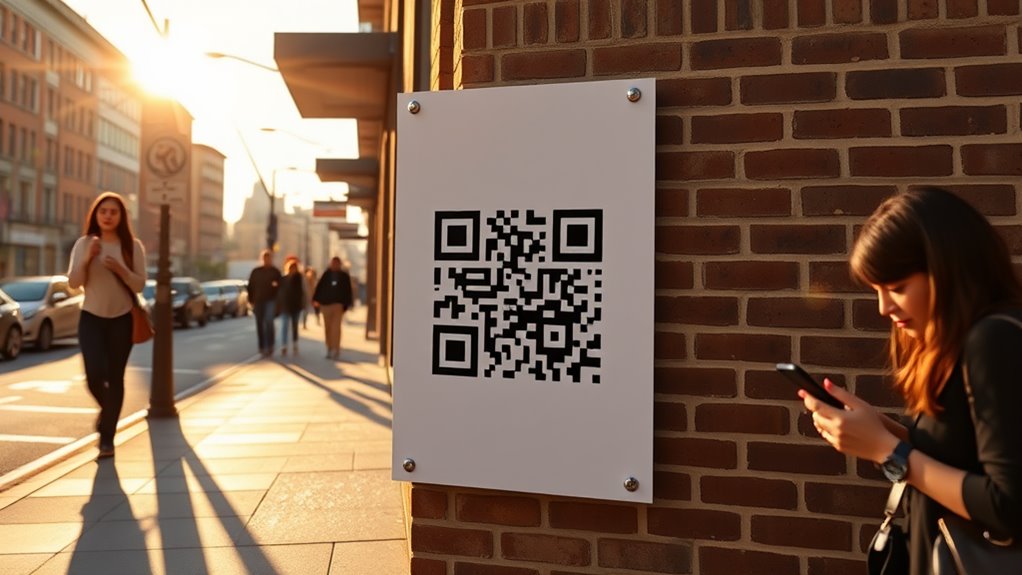
While traditional marketing methods continue to evolve, QR codes have emerged as a powerful bridge between print and digital advertising. You'll find these versatile squares transforming static displays into interactive experiences that drive engagement and provide measurable results.
Key Benefits of QR Code Marketing:
- Instant access to your digital content
- Real-time tracking and analytics
- Cost-effective implementation
- Easy updates without reprinting materials
How to Implement QR Codes Effectively:
- Place codes on business cards, product packaging, and storefront windows
- Link to landing pages optimized for mobile devices
- Include clear calls-to-action beside each code
- Test scannability in various lighting conditions
You can enhance your marketing strategy by using QR codes to:
- Offer exclusive discounts and promotions
- Share product demonstrations and tutorials
- Collect customer feedback
- Enable contactless payments
- Direct customers to your social media profiles
Remember to monitor your QR code campaign's performance through analytics platforms. You'll want to track metrics like scan rates, peak usage times, and conversion rates to optimize your strategy continuously. Consider using dynamic QR codes that allow you to modify linked content without replacing the code itself.
Mobile Apps and Push Notifications
Building on the direct engagement of QR codes, mobile apps and push notifications offer an even more personalized connection with your audience. Your business can create a dedicated platform that delivers real-time updates, exclusive offers, and targeted content directly to your customers' smartphones.
Key Benefits:
- Instant message delivery with 90% open rates within three minutes
- Location-based targeting for relevant, timely promotions
- Cost-effective compared to traditional print materials
- Detailed analytics tracking user engagement and behavior
Implementation Strategies:
You'll want to focus on developing an app that provides genuine value while incorporating these essential features:
- User-friendly interface with easy navigation
- Personalized content based on customer preferences
- Seamless integration with your existing systems
- Strategic push notification scheduling
Best Practices for Push Notifications:
- Limit messages to 2-3 per week to avoid notification fatigue
- Craft compelling headlines under 10 words
- Include clear calls-to-action
- Time your notifications based on user activity patterns
Remember to maintain a balance between promotional and informational content, ensuring you're delivering value that keeps users engaged and responsive to your communications.
Interactive Digital Signage
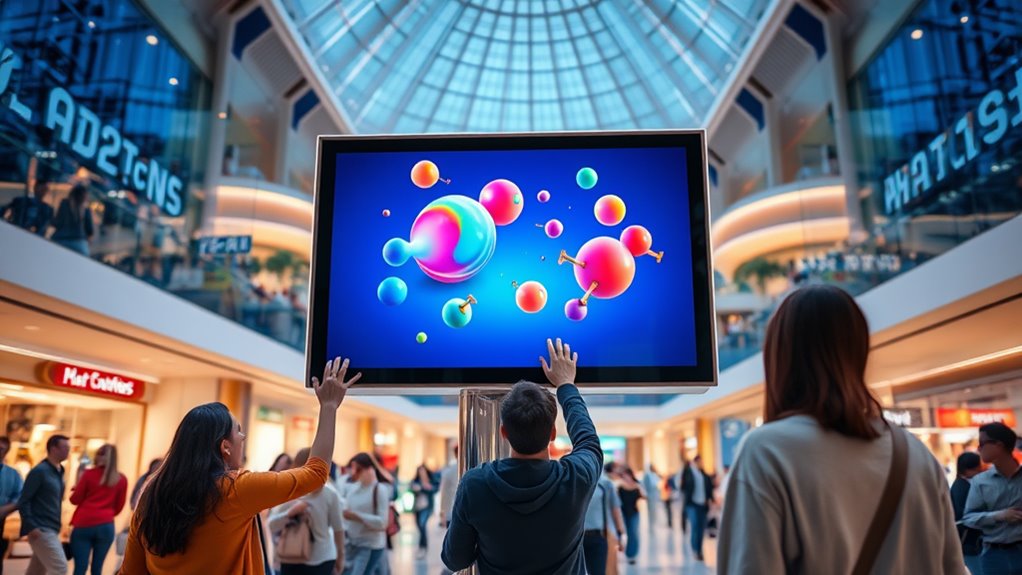
- Real-time content updates that let you adjust messaging instantly, saving time and resources while maintaining relevant information for your audience
- Analytics tracking that measures viewer engagement, dwell time, and interaction patterns, helping you optimize your content strategy
- Multi-touch capabilities that enable customers to explore product catalogs, maps, or menus independently, reducing staff workload
- Integration with social media feeds and live data that keeps content fresh and encourages audience participation
You can place these displays in high-traffic areas where they'll generate up to 400% more views than static signage. The technology allows for seamless content management through cloud-based systems, ensuring your messaging stays consistent across multiple locations while reducing your environmental impact compared to traditional printed materials.
SMS Text Message Campaigns
Text message campaigns deliver marketing content directly to your customers' phones, reaching an impressive 98% open rate compared to email's typical 20%. By leveraging SMS marketing, you'll connect with your audience instantly, making it an effective alternative to traditional paper flyers.
Key Benefits of SMS Campaigns:
- Real-time delivery with 90% of messages read within 3 minutes
- Location-based targeting capabilities
- Measurable engagement metrics and analytics
- Cost-effective compared to print materials
- Environmentally friendly solution
Implementation Strategies:
- Build your subscriber list through opt-in methods
- Segment your audience based on demographics and preferences
- Create concise messages limited to 160 characters
- Include clear calls-to-action with trackable links
- Schedule messages during peak engagement hours
Your SMS campaign can include various content types, such as promotional codes, event reminders, or flash sales. You'll want to maintain a consistent sending schedule while avoiding message fatigue – aim for 4-8 messages per month. Remember to comply with SMS marketing regulations by including opt-out instructions and obtaining explicit consent from subscribers.
Location-Based Marketing Solutions
Through strategic geofencing and beacon technology, location-based marketing lets you target customers when they're near your business or in specific areas of interest. You'll benefit from real-time engagement that traditional flyers simply can't match, while delivering personalized promotions to potential customers at precisely the right moment.
Modern location-based marketing tools offer several powerful advantages for your business:
- Proximity Marketing: Set up virtual boundaries around your store to automatically send offers to customers within 500 feet of your location, increasing foot traffic by up to 40%
- Behavioral Targeting: Track customer movement patterns to understand peak visiting hours and optimize your promotional timing
- Competitor Analysis: Monitor activity around competing businesses to capture potential customers with better offers
- ROI Tracking: Measure campaign effectiveness through detailed analytics on customer responses and conversion rates
You can implement location-based marketing through various platforms like Google Ads, Facebook Local Awareness, or specialized apps. By combining this technology with your existing marketing strategy, you'll create a dynamic system that reaches customers when they're most likely to make purchasing decisions.
Conclusion
In today's digital landscape, you'll find that traditional paper flyers have evolved into dynamic digital touchpoints, much like seeds transforming into a flourishing digital garden. Just as a compass points to multiple directions, you've now got several powerful alternatives at your fingertips. From engaging newsletters to interactive signage, you can reach your audience where they naturally gather – in the digital spaces they frequent daily. It's time to embrace these modern marketing channels.